
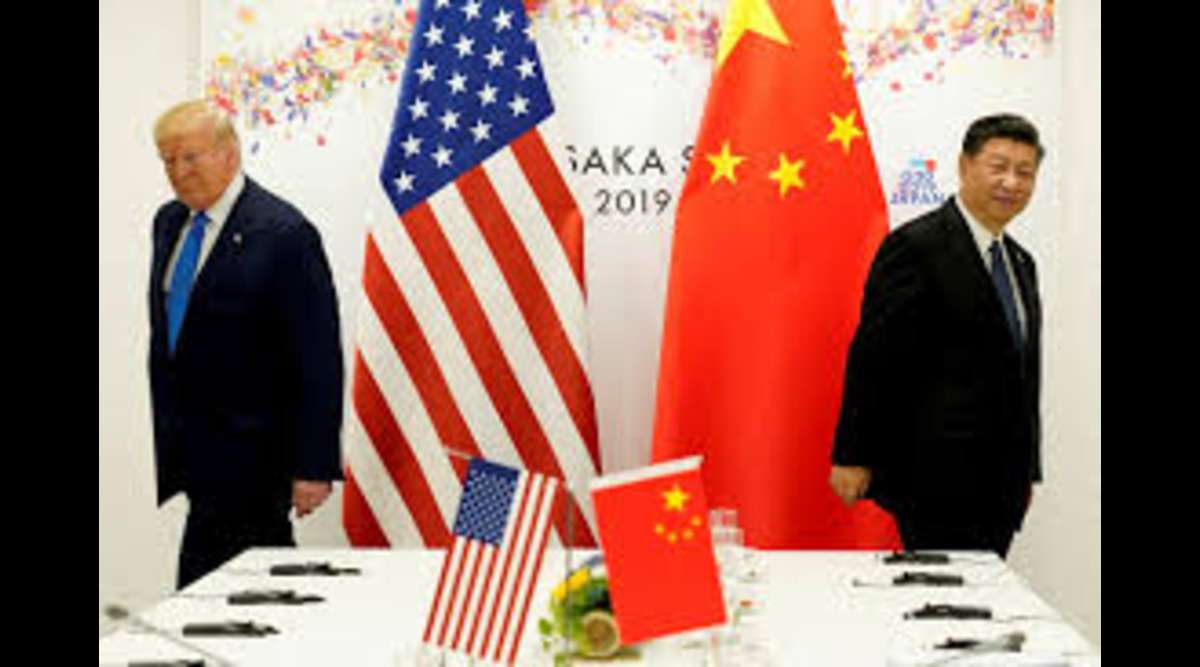
Less than a year into Donald Trump’s initial trade war with China, Chinese President Xi Jinping paid a high-profile visit to a humble factory in Ganzhou, a factory town huddled between rolling hills in the nation’s southeast.
Walking through its exhibition hall in 2019, Xi inspected row after row of plain-looking gray metal blocks and announced to his retinue of Communist Party leaders: “Rare earths are a vital strategic resource.”
Almost six years later, China’s control over the supply chain of rare earths has come to be one of its strongest weapons in an escalated trade war with the United States president. The minerals – which are employed to fuel everything from iPhones to electric cars – are critical materials for the sorts of cutting-edge technology that will shape the future.
And unlike tariffs, it’s an arena where Trump has limited space to strike back in kind.
Rare earths are a family of 17 elements more plentiful than gold and available in most countries, the United States included. But they’re hard, expensive and environmentally toxic to mine and refine.
For years, Beijing has been the US and the rest of the world’s dependence on supply of these refined metals. China produces 61% of the world’s mined rare earths, but its dominance at the processing level is 92% of world output, based on the International Energy Agency.
On April 4, after years of implicit threats, the Chinese government imposed export restrictions on seven kinds of rare earth minerals, in its response to Trump’s original 34% “reciprocal” tariffs on Chinese products. The new regulations demand all firms to obtain government approval to export the seven minerals and related products, such as magnets.
Rare earth magnets make possible smaller, more efficient motors and generators that power smartphones, car and jet engines, and MRI machines. They are also critical parts of a variety of high-ticket weapons, ranging from F-35 stealth fighter planes to nuclear-powered attack submarines.
It’s China demonstrating that it can wield amazing economic power by being strategic … and surgical and really punching American industry where it aches,” Justin Wolfers, a professor of economics and public policy at the University of Michigan, said.
On Tuesday, Trump directed an investigation into the possibility of tariffs on strategic minerals, a larger group of minerals that include rare earth minerals, to assess how these imports are affecting America’s security and resilience.
“America’s reliance on imports and the fragility of our supply chains increase the risk to national security, defense preparedness, price stability, and economic prosperity and resilience,” Trump said in an executive order.
Since the initial Trump administration, the US has been attempting to play catch-up and develop its own domestic rare earths supply chain. Three US rare earth industry firms informed CNN that they are expanding production capacities and procuring materials from US allies and partners.
But efforts will take years to fulfill the huge demand from critical US industries.
What are the key implications of suspended orders in legal or financial systems?
At least for now, the effects of Beijing’s export controls are being felt rapidly on the ground.
John Ormerod, founder of rare earth magnet consultancy JOC, explained to CNN that exports of rare earth magnets owned by at least five US and European firms have been suspended in China since the order was imposed.
“They were surprised so there is a great deal of confusion on their part and they required clarification from the authorities on what is needed (to get the necessary export licenses),” he said.
Joshua Ballard, CEO of USA Rare Earth, stated the export controls target “heavy” rare earths, which are 98% controlled by China. (Heavy rare earths are rarer, more difficult to process and more expensive.) This is to say that firms now have to obtain Beijing’s permission to supply these essential materials to important American industries, he added.
“Currently, literally these exports are suspended,” Ballard stated. “We don’t have a lot of back stock of this in inventory here in the US … This is China’s best bet. They don’t have much leverage when it comes to tariffs on us, but they sure do have leverage here.”
The export controls single out not just individual materials but also alloys and commodities wherein the elements are embedded even in trace amounts, added Ginger International Trade and Investment director Thomas Kruemmer, whose Singapore-based mineral and metal supply chain company has clients in numerous countries. “A great number of exports are now caught under this licensing system,” he continued, adding that there would be some delays as the exporters get accustomed to the new regime.
Decades in the making
China had an early start in rare earth mining, starting in the 1950s, state media say, but it wasn’t until the late 1970s that the industry really gained traction.
At the time, China married its low cost of labor and relatively lenient environmental regulations with the importation of foreign technology, says Stan Trout, owner of the rare earths and magnetic materials consulting firm Spontaneous Materials.
“Much of the technology that they brought in was developed here in the US, or in Japan, or in Europe,” he said. “And over time, I’m sure they’ve made improvements to it.”
As the country’s rare earth production increased, Beijing gradually understood the strategic importance of the minerals. “There was a recognition that this could be a very important technology for them to master,” Trout added.
In 1992, on a tour of one of the nation’s primary rare earth production bases in Inner Mongolia, Deng Xiaoping, the late Chinese leader who led the nation’s economic reforms, famously declared: “While there is oil in the Middle East, China has rare earths.” Now, China has made Deng’s dream come true by controlling the whole supply chain for the products.
Though labor is more expensive these days, China’s dominance of the sector has been solidified due to its “willingness to spend on the technology, the R&D, and automation” in a capital-intensive industry, Ormerod said.
American firms used to produce these rare earth magnets. But they slowly phased out of the business as cheaper Chinese competitors became available, Ormerod said.
“Lost the expertise, lost the human resource capacity and it’s a highly capital-intensive business,” he said.
Today, it is hard to match the “Chinese price,” due to the nation’s larger economies of scale, as well as government subsidies that provided them with an added advantage, Ormerod said.
From 2020 to 2023, the US imported 70% of all rare earth compounds and metals, according to a US Geological Survey report this year.
Challenge and opportunity for the US
The newest export controls are not the first instance Beijing has used its industry dominance. In 2010, China suspended exports of rare earths to Japan for close to two months in a dispute over territory. In late 2023, Beijing banned rare earth extraction and separation technologies.
Beijing has also stifled exports of other key minerals that are essential to the economy and supply chains around the world.China’s export controls have given the rest of the world very little option, industry insiders and experts said. But America is filling the void.Since 2020, the US Department of Defense has paid over $439 million to build domestic rare earth element supply chains. And it has committed to creating a sustainable, mine-to-magnet supply chain that can meet all US defense needs by 2027.
Some US companies view China’s export restrictions as a chance to accelerate domestic production and encourage a more robust supply chain outside China.Nicholas Myers, head of Phoenix Tailings, a Massachusetts start-up that processes rare earths, said his firm has built technology to extract rare earth minerals with “zero waste, zero emissions” to metals and metal alloys, getting the materials from domestic ores and also Canada and Australia.
His firm now manufactures 40 metric tons of rare earth metals and alloys annually and plans to ramp up to 400 tons with a new New Hampshire facility.
“It’s all domestic processing. We don’t rely on anything from China,” he said.
“America absolutely has the capability to be in a position to produce the rare earths at the timelines that we actually need it. We just need to ensure that all the policymakers, all the customers are concentrated on backing the industry to actually scale up,” Myers further stated.
U.S. companies are gaining traction in some parts of the supply chain as well.
USA Rare Earth is constructing a magnet factory in Texas, with the goal of making 5,000 tons of rare earth magnets a year; it also has a heavy rare earths-rich deposit in West Texas, along with all the minerals on China’s most recent export control list, its CEO Ballard says. (The deposit is also heavy with gallium, a key material China prohibited from export to the US in December.)
But the processing technology to get minerals out of the rocks is still being developed by the company, Ballard added.
“How do we do it quicker? How do we unlock these assets that we have in the US, as limited as they are? We have to unlock what we have and construct as fast as we can,” he said.
After all the discussion, American businesses might finally have the motivation they require to do the hard work of re-building the industry for processing and extracting raw materials that is essential to winning a technology competition with China.
CNN’s Yong Xiong and Isaac Yee contributed to the reporting.