

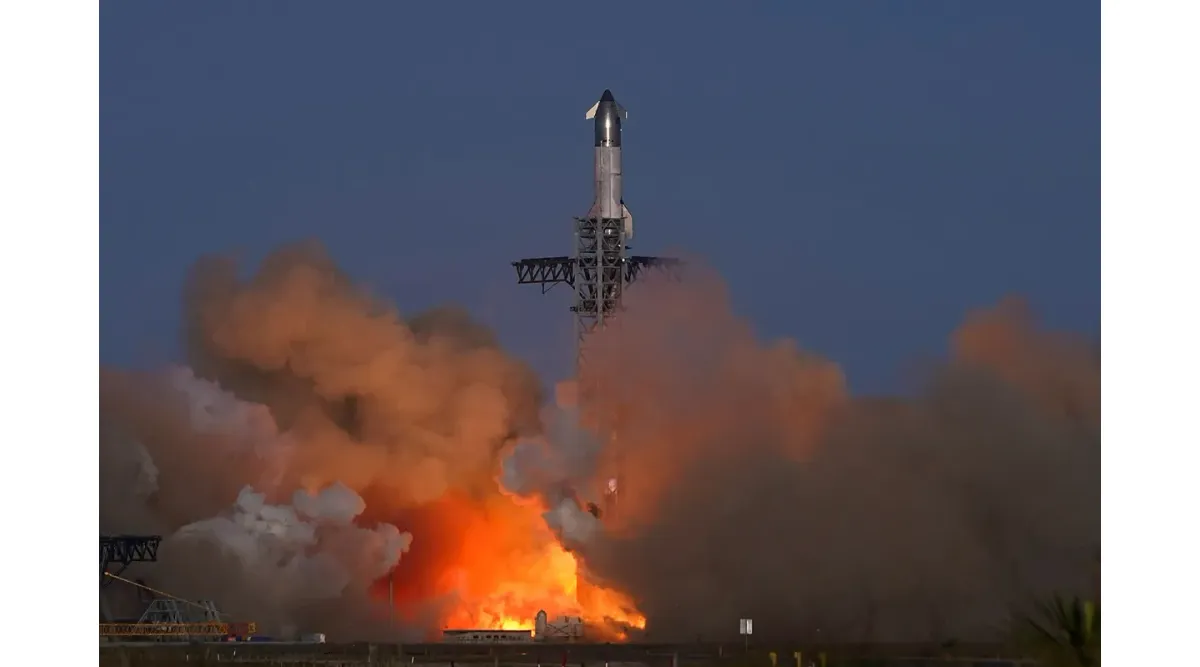
In a highly anticipated event, SpaceX launched its Starship test flight from Boca Chica, Texas on Thursday. This was the eighth attempt for the spacecraft, part of a series of tests aimed at refining what is touted as the most powerful launch system ever built. Unfortunately, just like its predecessors, this flight ended in failure, raising new questions about the program’s future.
The mission began at 5:30 p.m. CT as Starship took to the skies atop the Super Heavy booster. For the first 2.5 minutes, everything seemed to be on track. The Super Heavy successfully detached from the Starship’s upper stage and was set to land safely back at the launch site. However, just minutes later, the upper stage began to experience catastrophic engine failures. With several engines cutting out, the craft lost its attitude control and ultimately tumbled out of communication with the ground crew. It’s moments like these that highlight the unpredictable nature of space exploration.
SpaceX’s communications manager, Dan Huot, noted during the livestream that losing several engines would inevitably lead to a loss of control. “Once you lose enough of those center engines, you’re going to lose attitude control,” he explained. The explosion was reportedly visible from miles away, with residents in Florida and the Caribbean sharing their experiences of witnessing the fiery descent of the spacecraft.
In the immediate aftermath, the Federal Aviation Administration (FAA) took precautionary measures, halting flights into major Florida airports including Miami and Fort Lauderdale due to falling debris. This situation reflects the broader implications of these test flights. Thousands of passengers faced delays, demonstrating that the impacts of such ambitious testing extend far beyond the launch site.
SpaceX quickly issued a statement following the explosion, indicating that an energetic event in the aft portion of the Starship resulted in a loss of several Raptor engines. They reassured the public that any surviving debris would have fallen within a predetermined response area, posing no risk to marine life or water quality. However, the FAA has mandated a thorough investigation into the mishap, ensuring that safety protocols are reinforced for future flights.
This incident is reminiscent of the previous test flight in January, which also ended in an explosion over the Turks and Caicos Islands. The question arises: why was SpaceX allowed to proceed with this latest flight before the investigation into the prior failure was complete? This concern underscores the ongoing debate about the safety of experimental rocketry, particularly when flights occur over populated areas.
In the face of these challenges, SpaceX continues to embrace its philosophy of rapid iterative development. The company is committed to learning from each flight, even those that end in failure. With each explosion, they gain valuable data that can be used to enhance the design and operational protocols of the Starship. CEO Elon Musk has emphasized this approach, stating, “We fly to learn.” As they move forward, it will be crucial for SpaceX to balance their ambitious goals with the safety of both the public and their spacecraft.